Turning Waste into Value: Inside CERNET's Feedstock Strategy
Turning Waste into Value: Inside CERNET's Feedstock Strategy
How do you turn an industrial waste gas into an amino acid, a biodegradable plastic, or an ingredient for a face cream? That question sits at the heart of CERNET's newly published deliverable, D2.4 – Feedstock management for CERNET demo sites, and the answer it offers is one of the more concrete contributions yet to Europe's push toward a circular bioeconomy.
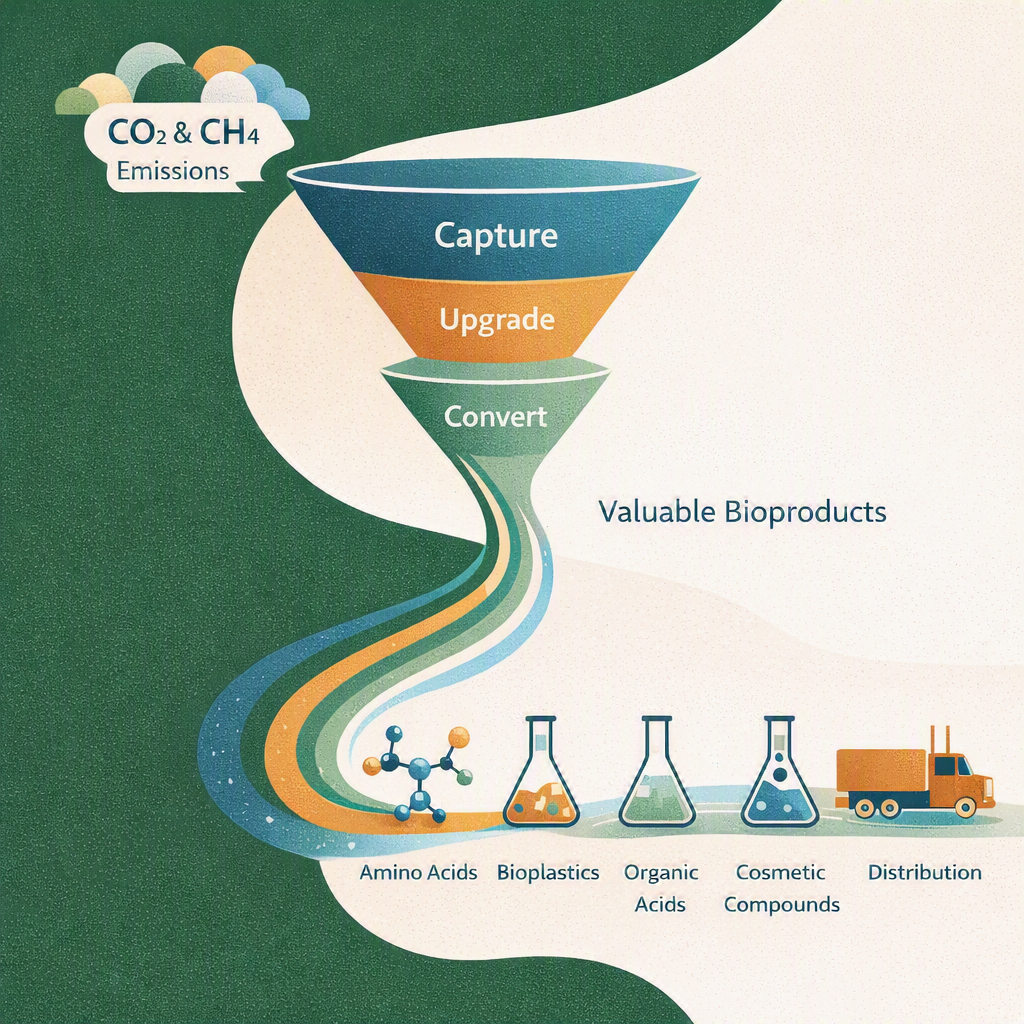
The starting point is a shift in perspective. The carbon dioxide and methane released by industries such as waste management, bioethanol production and winemaking are usually treated as emissions to be minimised. CERNET treats them as raw material. The deliverable sets out, in practical detail, how these biogenic gases can be captured, cleaned, moved to where they are needed and converted into things worth selling: amino acids, organic acids, biopolymers and cosmetic compounds among them. The result is a form of industrial symbiosis, where one sector's waste becomes another's feedstock.
Three demonstrations, three very different settings
Much of what makes the report credible is that it isn't theoretical. It draws on three demonstration sites, each rooted in a different industry and a different corner of Europe.
In Italy, DEMO I works with municipal organic waste. The biogenic CO₂ left over from biogas upgrading is fed into fermentation, which converts it into protein-rich biomass and amino acids.
DEMO II spans Bulgaria and Slovenia and shows what a cross-border value chain looks like in practice. CO₂ from bioethanol production is transported between the two countries and turned into methanol, which then becomes the building block for specialty chemicals including L-alanine, L-malic acid and sorbitol.
In Spain, DEMO III combines two emission sources, wineries and biogas plants, and works with both CO₂ and methane. Here the gases are converted into biodegradable plastics (PHA) and Ectoine, a high-value compound used in cosmetics.
Taken together, the three pilots make the same point from different angles: the approach travels. It holds up across sectors, geographies and feedstock types, even if each setting brings its own operational headaches.
A blueprint, not just a proof of concept
What sets D2.4 apart is its focus on the unglamorous middle of the process. Plenty of projects can show that a conversion works in the lab. Fewer can explain how to source the feedstock reliably, characterise it, store it, ship it across a border and keep the whole thing within the rules. That is the gap this deliverable sets out to fill.
It does so by establishing an operational baseline for the entire feedstock lifecycle. Standardised assessment frameworks make sure a given feedstock actually matches the conversion technology it is destined for. Logistics planning covers cross-border transport, storage requirements and the contingencies for when something goes wrong. The report is also honest about risk, naming feedstock variability, transport constraints and regulatory uncertainty as issues to plan around rather than hope away. And it proposes coordination models to keep the many industrial partners along each value chain working in step.
The intent is clearly forward-looking: get these foundations right at pilot scale, and the same methods should support industrial roll-out and replication later on.
Sustainability built in, not bolted on
The project's environmental logic is strict by design. Feedstock is limited to biogenic and residual sources, meaning waste streams and fermentation gases, so the process never competes with food production for raw material. To guard against less obvious side effects, the framework also factors in Indirect Land Use Change (ILUC) risk, checking that sourcing carbon in one place does not quietly cause harm somewhere else. Renewable energy, process optimisation and improved downstream processing are then applied across all three demos to push emissions down and resource efficiency up.
The hard parts, named out loud
The deliverable is refreshingly direct about what stands in the way of wider deployment. Feedstock composition and availability vary. Coordinating partners across several countries is difficult. Regulation is fragmented, especially for cross-border transport. Infrastructure and storage have real limits. And the moment feedstock is generated rarely lines up neatly with the moment there is capacity to process it.
Naming these barriers early is the point. It turns them into a to-do list for better planning, standardisation and policy alignment, rather than nasty surprises further down the road.
Why it matters beyond CERNET
Because the methodology is meant to be transferable, its value reaches past the project's own demo sites. The same value chains could be replicated in new regions and industries. There is clear scope for synergy with other EU efforts on carbon capture, biotechnology and the circular economy. And the work feeds directly into policy questions that are still being settled: how to classify feedstocks, how to handle their transport, how to certify their sustainability.
The broader conclusion of D2.4 is straightforward enough. Biogenic carbon streams can be folded into real industrial value chains, as long as the technical, logistical and regulatory pieces are handled together rather than one at a time. Get that coordination right, and emissions stop being something merely to reduce. They become something to use.