Turning emissions into value: CERNET's framework for monitoring the circular bioeconomy
Turning emissions into value: CERNET's framework for monitoring the circular bioeconomy
The EU-funded CERNET project has published its public deliverable D2.3, KPIs and Monitoring Framework, setting out how it will measure the conversion of industrial emissions into useful products. The framework gives the project a consistent way to track progress across its carbon-conversion technologies.
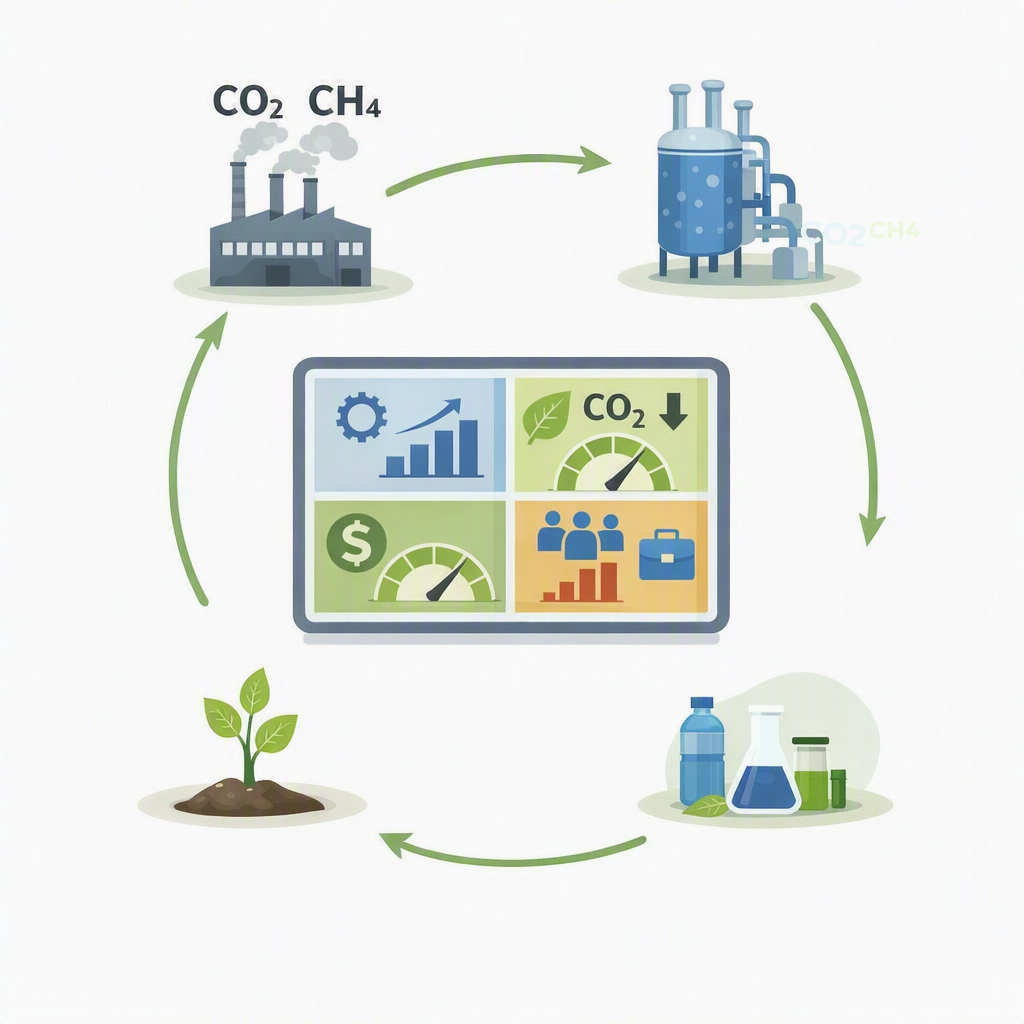
CERNET's aim is to close the carbon loop by converting biogenic carbon dioxide (CO₂) and methane (CH₄) into higher-value chemicals and ingredients through fermentation and catalytic processes.
From waste emissions to bio-based value chains
Across three industrial demonstrators, the project is developing four value chains:
- CO₂ from biogas into protein hydrolysates and L-alanine
- CO₂ into methanol, and then into amino acids and organic acids
- CO₂ into polyhydroxyalkanoates (PHA), a family of bioplastics
- Methane into ectoine, a high-value bio-based compound
Each pathway offers an alternative to fossil-based production, treating industrial carbon streams as a raw material rather than a waste to be disposed of.
Measuring impact across four dimensions
To check that these technologies deliver in practice, CERNET has built a monitoring framework covering four areas: technical performance (efficiency and process optimisation), environmental impact (such as carbon-removal potential and resource use), economic viability (costs and return on investment) and social outcomes (jobs, health and safety, and wider societal effects).
In total it defines 69 Key Performance Indicators (KPIs) and 55 Supplementary Indicators (SIs). Each demonstrator is assessed on its own terms, which avoids drawing misleading comparisons between processes that operate in very different contexts.
How the indicators were chosen
The KPI set was developed in four stages: reviewing project documentation and related EU initiatives; selecting indicators suited to each demonstrator; validating them with industrial and research partners; and finalising the metrics and monitoring procedures. All indicators follow the SMART criteria, specific, measurable, achievable, relevant and time-bound, so that they are both scientifically sound and practical to apply.
Tracking progress on the ground
The framework links each KPI to a responsible partner, a timeline and a measurement method. CO₂ capture rates and biomass yields track technical efficiency; carbon-removal potential and water use capture environmental benefits; levelised production costs and carbon-credit revenues indicate commercial potential; and job creation and worker safety reflect social value. Monitoring is coordinated across partners and work packages, so that data is collected consistently over the life of the project.
A resource for other projects
Because the approach is structured and transparent, it can be reused beyond CERNET. The project intends the framework to help other Horizon Europe and CBE JU initiatives replicate technologies across regions and sectors, compare results against EU monitoring standards, share knowledge with related projects, and support evidence-based decisions on policy and investment.
What comes next
The next phase will put the framework to work during implementation, generating the data needed to test the technical feasibility, environmental performance and economic viability of CERNET's value chains. That evidence will be central to market uptake, industrial replication and collaboration across Europe's growing bio-based sector.